Claude AI vs. ChatGPT: A Comparison for the Best Assistant in 2025 🤖
Table of Contents
1. Introduction: The AI Assistant Revolution
2. Meet the Contenders: Claude AI and ChatGPT
3. Core Capabilities and Performance
4. User Experience and Interface
5. Accuracy and Reliability
6. Creative Writing and Content Generation
7. Coding and Technical Assistance
8. Safety and Ethical Considerations
9. Pricing and Accessibility
10. Which AI Assistant Wins in 2025?
11. Frequently Asked Questions
12. Conclusion
Introduction: The AI Assistant Revolution 🚀
Remember when asking a computer for help meant navigating through endless menu options and getting frustratingly robotic responses? Those days feel like ancient history now. We’re living in an era where AI assistants can write poetry, debug code, help plan your vacation, and even engage in philosophical debates that would make Socrates proud.
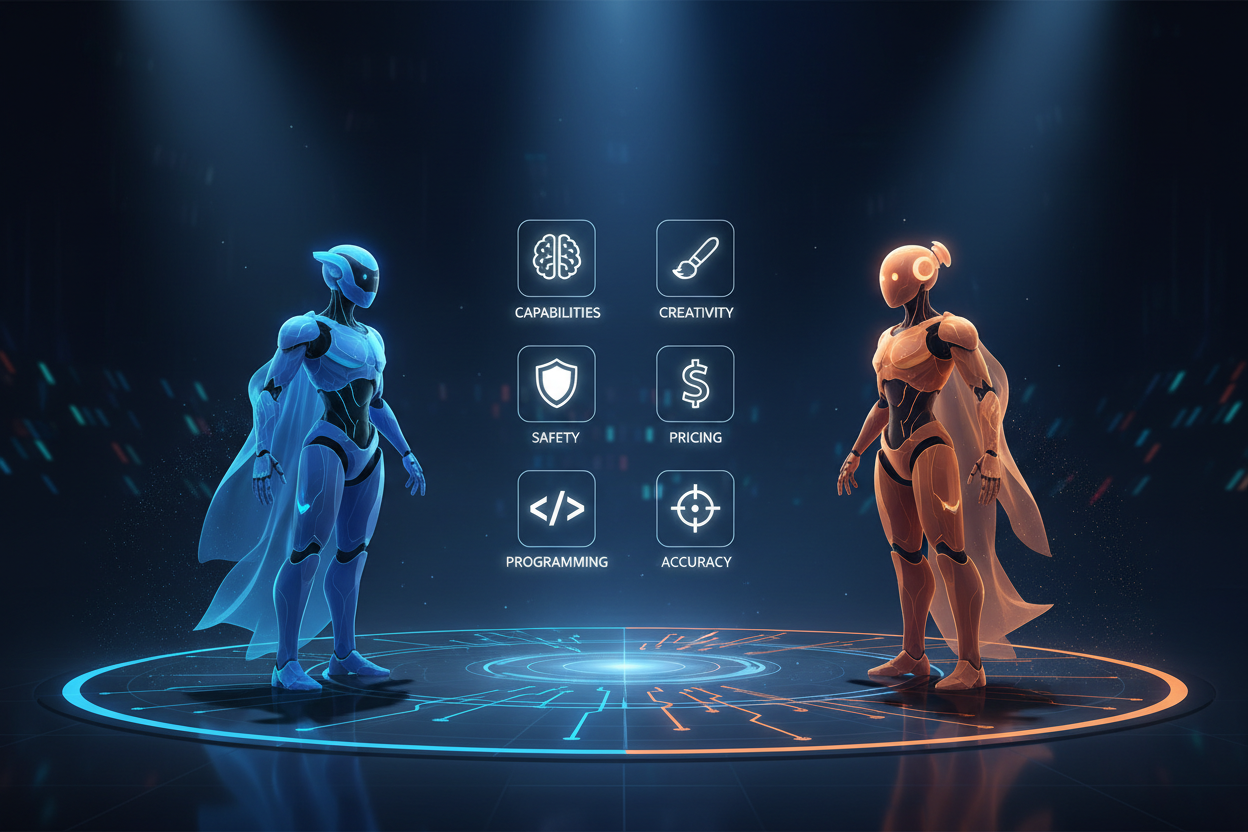
As we navigate through 2025, two AI powerhouses have emerged as the clear frontrunners in the virtual assistant space: Claude AI from Anthropic and ChatGPT from OpenAI. Both promise to revolutionize how we work, learn, and interact with technology, but which one truly deserves the crown as the best AI assistant?
I’ve spent countless hours testing both platforms, pushing their limits, and discovering their quirks. This comprehensive comparison will help you understand which AI assistant aligns best with your needs, whether you’re a student cramming for exams, a professional juggling multiple projects, or simply someone curious about the cutting edge of artificial intelligence.

Meet the Contenders: Claude AI and ChatGPT 🥊
Before diving into the nitty-gritty comparison, let’s get acquainted with our digital contestants. Think of this as the tale of two AI titans, each with their own personality, strengths, and approach to helping humans navigate the complexities of modern life.
ChatGPT burst onto the scene like a meteor, capturing global attention and sparking conversations about AI’s potential. Developed by OpenAI, it’s built on the GPT (Generative Pre-trained Transformer) architecture and has become synonymous with AI assistance for millions of users worldwide. The platform has evolved significantly since its initial release, with GPT-4 bringing enhanced reasoning capabilities and more nuanced understanding.
Claude AI, on the other hand, represents Anthropic’s vision of helpful, harmless, and honest AI. Named after Claude Shannon, the father of information theory, this assistant was designed with a strong emphasis on safety and constitutional AI principles. While it may not have ChatGPT’s early fame, Claude has been quietly building a reputation for thoughtful, well-reasoned responses and careful handling of sensitive topics.
Core Capabilities and Performance ⚡
When it comes to raw intellectual horsepower, both assistants pack a serious punch, but they flex their muscles in slightly different ways. It’s like comparing two elite athletes who excel in different sports – both are impressive, but their strengths shine in different arenas.
ChatGPT demonstrates remarkable versatility in handling diverse tasks. Whether you’re asking it to explain quantum physics in simple terms or help brainstorm marketing strategies for your startup, it adapts its communication style and depth to match your needs. The latest iterations show improved reasoning capabilities, better context retention throughout longer conversations, and an impressive ability to admit when it’s unsure about something.
Claude AI takes a more methodical approach to problem-solving. Where ChatGPT might dive straight into an answer, Claude often takes a moment to consider multiple angles before responding. This deliberative style particularly shines when dealing with complex ethical questions or nuanced topics that require careful consideration. Users frequently note that Claude’s responses feel more thoughtful and less prone to confident-sounding mistakes.
In terms of processing speed, both platforms deliver responses quickly enough for real-time conversation. However, Claude sometimes takes slightly longer to formulate responses, which many users interpret as a sign of more careful consideration rather than slower processing.
User Experience and Interface 💻
The way we interact with technology can make or break our experience, and both AI assistants understand this fundamental truth. However, they’ve taken notably different approaches to creating user-friendly environments.
ChatGPT’s interface feels familiar and accessible, resembling a clean messaging app that most people can navigate intuitively. The conversation flows naturally, with clear message bubbles and easy-to-read formatting. OpenAI has also introduced features like conversation history, allowing users to pick up where they left off days or weeks later. The mobile app experience is particularly polished, making it easy to get AI assistance on the go.
Claude AI opts for a more minimalist approach that some users find refreshing. The interface doesn’t overwhelm you with options or distracting elements – it’s just you and the AI, ready to have a meaningful conversation. While this simplicity is appealing, some users miss the additional features and customization options available in other platforms.
One area where both assistants excel is in handling follow-up questions and maintaining context throughout extended conversations. Gone are the days when you had to repeat yourself or start from scratch with each new query.
Accuracy and Reliability 🎯
Here’s where things get interesting, and honestly, where I’ve noticed some of the most significant differences between these AI assistants. Accuracy isn’t just about getting facts right – it’s about understanding context, providing relevant information, and knowing when to express uncertainty.
ChatGPT has made tremendous strides in accuracy since its early days. The training improvements and fine-tuning have resulted in fewer obvious errors and better fact-checking capabilities. However, it can still occasionally present information with confidence even when uncertain, a trait that requires users to maintain a healthy skepticism and verify important information independently.
Claude AI has built a reputation for being more cautious with factual claims, often providing caveats and encouraging users to verify information from authoritative sources. While this might seem less convenient, it actually builds trust over time. Claude is more likely to say “I’m not certain about this specific detail” rather than guess, which I personally find more helpful for important decisions.
Both assistants perform well with current events and recent information, though users should remember that AI training data has cutoff dates, and neither assistant has real-time internet browsing capabilities in their standard versions.
Creative Writing and Content Generation ✍️
If you’re a content creator, writer, or anyone who regularly needs to generate creative text, this section might be the most crucial for your decision-making process. Both assistants can help with everything from blog posts to poetry, but they bring different creative personalities to the table.
ChatGPT often feels like that enthusiastic creative partner who’s always ready to brainstorm. It can switch between writing styles effortlessly, whether you need a formal business proposal or a whimsical children’s story. The assistant excels at understanding creative prompts and can help develop ideas in unexpected directions. Many content creators appreciate its ability to generate multiple variations of the same concept quickly.
Claude AI approaches creativity with what I’d describe as thoughtful artistry. Its creative outputs often feel more carefully crafted, with attention to nuance and subtlety that can be particularly valuable for sophisticated content. When writing longer pieces, Claude tends to maintain consistency in tone and style more effectively, making it excellent for projects requiring sustained creative voice.
Both assistants can help with editing and improving existing content, though they approach this task differently. ChatGPT might offer bold suggestions for restructuring, while Claude often focuses on refinement and enhancement of existing elements.
Coding and Technical Assistance 👨💻
For developers, data scientists, and anyone working with code, having an AI assistant that truly understands programming can be a game-changer. Both platforms have proven themselves capable coding companions, but with distinct approaches to technical problem-solving.
ChatGPT has become incredibly popular among programmers for its ability to write, debug, and explain code across multiple programming languages. It can help you understand complex algorithms, suggest optimizations, and even help troubleshoot those frustrating bugs that keep you up at night. The assistant is particularly good at explaining programming concepts to beginners, breaking down complex topics into digestible pieces.
Claude AI brings a more systematic approach to coding assistance. When you present a programming problem, Claude often starts by understanding the broader context and requirements before diving into specific solutions. This methodical approach can be particularly valuable for larger projects where understanding the big picture is crucial. Many developers report that Claude’s code suggestions tend to be more robust and include better error handling.
Both assistants can help with documentation, code reviews, and learning new programming languages. However, remember that while AI-generated code can be incredibly helpful, it should always be reviewed and tested thoroughly before implementation in production environments.
Safety and Ethical Considerations 🛡️
In an era where AI safety and responsible development are paramount concerns, how these assistants handle sensitive topics and potential misuse becomes critically important. This isn’t just about preventing harmful content – it’s about building AI that genuinely serves human wellbeing.
ChatGPT has implemented robust safety measures and content filtering systems. It’s designed to refuse generating harmful content, avoid biased responses, and decline requests for illegal or unethical assistance. OpenAI has invested heavily in alignment research and continues refining these safety mechanisms based on user feedback and emerging challenges.
Claude AI was built from the ground up with Anthropic’s Constitutional AI approach, which emphasizes harmlessness and honesty as core principles. This means Claude often provides more nuanced responses to ethically complex questions, acknowledging different perspectives while maintaining clear ethical boundaries. Users frequently note that Claude seems more thoughtful when discussing controversial topics, often providing balanced viewpoints rather than avoiding the discussion entirely.
Both assistants handle personal information responsibly and include privacy protections, though users should always be cautious about sharing sensitive data with any online service.
Pricing and Accessibility 💰
Let’s talk about the elephant in the room – cost. While both platforms offer free tiers, understanding the pricing structure and what you get for your money is crucial for making an informed decision.
ChatGPT offers a generous free tier that provides access to GPT-3.5, which is still remarkably capable for most users. The ChatGPT Plus subscription unlocks GPT-4, faster response times, and priority access during peak usage periods. For many users, the free tier provides sufficient functionality for casual use, while the paid tier becomes valuable for heavy users or those requiring the most advanced capabilities.
Claude AI’s pricing structure is more straightforward, with clear usage limits and transparent pricing for additional usage. The free tier provides substantial functionality, and the paid options scale based on actual usage rather than flat subscription fees. This can be more cost-effective for users with variable AI assistance needs.
Both platforms offer API access for developers, though pricing and rate limits vary. Consider your specific usage patterns when evaluating which pricing model works best for your situation.
Which AI Assistant Wins in 2025? 🏆
After extensive testing and comparison, the truth is that there’s no universal winner – the best choice depends entirely on your specific needs, preferences, and use cases. However, I can offer some guidance on which assistant might be the better fit for different scenarios.
Choose ChatGPT if you value versatility, speed, and a more conversational interaction style. It’s particularly excellent for creative projects, general knowledge questions, and situations where you need quick, confident responses. The extensive user community and third-party integrations also make it a solid choice for those who want to integrate AI assistance into existing workflows.
Choose Claude AI if you prioritize thoughtful, nuanced responses and appreciate a more cautious approach to information sharing. It’s particularly strong for complex analysis, ethical discussions, and situations where accuracy and careful reasoning are more important than speed. Users who value transparency about uncertainty will likely prefer Claude’s approach.
For many users, the ideal solution might actually involve using both assistants for different purposes, leveraging each one’s strengths where they shine brightest.
Frequently Asked Questions ❓
Q: Can I use both Claude AI and ChatGPT for free?
A: Yes, both platforms offer free tiers with substantial functionality. However, paid subscriptions unlock additional features, faster response times, and access to more advanced models.
Q: Which AI assistant is better for students?
A: Both are excellent for educational purposes. ChatGPT might be better for quick homework help and creative projects, while Claude AI excels at helping students think through complex problems and develop critical thinking skills.
Q: Are these AI assistants safe for business use?
A: Both platforms have business-grade options with enhanced privacy and security features. However, always review the terms of service and consider your company’s data protection requirements.
Q: Can these AI assistants browse the internet?
A: In their standard versions, neither assistant can browse the internet in real-time. They rely on their training data, which has specific cutoff dates.
Q: Which assistant is better for coding?
A: Both are capable coding assistants. ChatGPT might be better for quick coding help and learning programming concepts, while Claude AI often provides more thorough, well-documented solutions.
Q: How do I know if the information provided is accurate?
A: Always verify important information from authoritative sources. Both assistants can make mistakes, and Claude AI is generally more upfront about uncertainty.
Conclusion: The Future of AI Assistance 🌟
As we’ve explored throughout this comprehensive comparison, both Claude AI and ChatGPT represent remarkable achievements in artificial intelligence. They’re not just tools – they’re glimpses into a future where AI assistance becomes as natural and essential as using a search engine or sending a text message.
The competition between these platforms ultimately benefits all of us. It drives innovation, improves safety measures, and pushes the boundaries of what’s possible in human-AI interaction. Whether you choose ChatGPT’s versatile enthusiasm or Claude AI’s thoughtful deliberation, you’re gaining access to capabilities that would have seemed like science fiction just a few years ago.
My recommendation? Start with the free tiers of both platforms and spend time understanding how each one fits into your workflow. Pay attention to which assistant’s personality and approach resonate with your working style. The best AI assistant for 2025 isn’t necessarily the most advanced one – it’s the one that enhances your productivity, creativity, and decision-making in ways that feel natural and valuable.
As these platforms continue evolving, we can expect even more impressive capabilities, better safety measures, and more intuitive interactions. The AI assistant landscape of 2025 is just the beginning of a transformation that will reshape how we work, learn, and solve problems. The future is conversational, and it’s incredibly exciting. 🚀